Showing posts with label B. Depict assignment. Show all posts

Wednesday, 4 December 2013

Evaluation of Final DepicT! Product

Random Acts

For this exercise we had to produce a short film which lasted around roughly 90 seconds for a film competition called 'DepicT!'.

Our 90 second film is about random acts of kindness which are made by a few members of the public, if you watch the film it will become a lot clearer to what our idea consisted of.

Below is a copy of our film: 


Our first scene shows George coming out of a classroom, he then turns his head to see a group of rowdy teens walking down a corridor towards him, as he sees this tense/action music begins to play, he is instantly worried/scared by the teens and begins to head in the other direction. The camera pans and follows him walking away quickly.
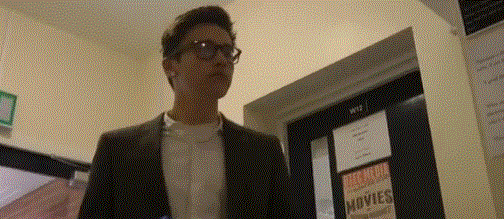

This is the shot of George looking at the teens

This is the  long shot of the teens waling down the corridor
The next shot is a CU Low angle showing George
After this scene of events, the teens begin to catch up to George, at this point the scene becomes very tense, and this leaves the audience thinking about what could the teens want or want to do to George. All is revealed when one of the teens catches up with George and places their arm on him to catch his attention, at this point there is a match in action. George turns around and the teen hands George something, the camera then pans down to the teen with his wallet in his hand.

Here is the shot of the teen handing George the wallet:


Once George has the wallet he smiles worryingly, because he does not know how to react this 'Random Act', happy upbeat music then begins to play then he walks away in slow motion and then heal-clicks as he walks away. 

We then see a side on medium shot of George walking through a park and coming across a bench with a young girl on it.


The establishing shot uses a 'fade in' edit on the title; Random Acts. We initially chose to use a black font, but after discussion we came to the conclusion that using a brighter shade would stand out more and therefore be more effective. The title of the production itself allows the audience to have a slight insight into what the short clip is about, however it still leaves room for their imagination, and doesn't give away any moral clues beforehand. 


The camera shot and angles used in this scene work well with the tension and ambiguity of the script. In comparison with the title of our clip, the music used in this scene also leaves room for the audience to create their own version of events leading into the following shot. 

Overall, the editing of this short film is well thought out and consistent. Given our time frame, I think that we worked well and edited the bits that were necessary to the best of our abilities. If we were to repeat this task, I think that given more time, the editing would have been more precise and of a better standard. The end credits is my personal favourite bit of our editing- with the colour consistency on the speech bubbles, and the speed of the transitions between each specific credit. 


If we were to have more time and re-produce this clip, I would place a shot between these two, to show that George is playing the same character, as there is no transitional shot to show that he's changed costumes, and this therefore may lead to confusion for the audience. 

The sound throughout the video is consistent with the footage that is shown, and although we had to dub a lot of our dialogue, I believe that the sound is still synchronous with the movement of the specific characters lips. There is one point, however, when the geek is talking to the girl, where there is no sound played what-so-ever, and so if I was given the chance to repeat this task, I would at least add some ambient sound into that short piece of footage. We wanted to ensure that the tone of the music fitted in with the mood and overall tone of the footage that was being presented at any given time, hence why some of the soundtracks jump from tense and dramatic, to happy and celebratory. As an example, when the youths are following the 'geek', the music is of a deep tone and carries connotations of tension and nervousness. It then changes, however, to upbeat and happy, when the 'geek', and therefore the audience, realize that the youths were only trying to help and make a 'random act' of kindness. 

Planning For My 90 Second DepicT!


Idea
An individual going about their daily life when someone acts out an act of kindness towards them, thus leading that individual to do the same to another stranger and so on. We follow the first person who has been helped, and then follow the next etc. This repeats itself a total of 4 times.


Description
A young gentleman leaves his home with a pack lunch box and briefcase, ready for a day of work. He then sees a group of stereotypical ‘thugs’ gathered near his house, leading him to feel intimidated and change direction. He attempts to walk away but is being called at from behind by one member of the group. Gradually speeding up his walking, the ‘thug’ catches up with him and places a hand on the young man’s shoulder. Terrified, the young man turns around to see that the ‘thug’ is, in fact, handing over the young man’s wallet which he dropped whilst trying to rush away from the group. The young man thanks the other person and they exchange smiles.

The young man then walks away and into a park where he sees a young girl sitting alone. She’s on a bench, eating sweets and reading a comic book. The man realises he has a bit of time before he has to go to work, and so places himself next to the little girl on the bench. He starts polite conversation and proceeds to hand over an apple, taken from his lunch box. He asks her to promise him to eat the apple after all her sweets, as even though they’re okay in moderation, sweets are generally bad for you. She politely laughs, packs the apple, remainder of her sweets and comic in her bag, and skips off. 


We then follow her, and her journey to the library. She sits next to an elder man who is also sitting outside the library, alone, waiting for it to open. She says “hello” enthusiastically, whilst the elder gentlemen replies in a monotone “hi.” She asks him where his friends are and he explains that he doesn't have any. Feeling sympathetic for this man, she offers him her comic to read, he gratefully accepts and so the little girl continues to skip away. The elderly man smiles to himself and opens the comic; we see a close up of “random acts of kindness make the world go round”, and as he turns the pages, the credits are imprinted to look like part of the comic, with music in the background.

Shots

1 - Fade in, establishing shot of character leaving house
2 - Slightly low angled long shot of character leaving home, walking towards the camera, becoming bigger.
3 - This leads to a point of view shot, beginning looking straight, then a pan right then we hear a voices to the left and we pan left, this is for the viewers to establish the location. When panning left we see a group of youths walking towards the geek. The camera then cuts to a low angled shot of the group of teens walking and being rowdy with music playing aloud etc.
4 - We cut to a low angled tracking shot of the man walking through his gate and turning right, walking on the pavement, . The tracking shot then turns into another tracking shot but from the front of the character with the group in the background.
5 - We then cut back to a tracking shot from behind the character, we begins to hear shouting, the group are calling for the man; he begins to walk faster and faster, we then see a hand placed on the character's back.
6 - The geek turns around and we see a shot reverse shot, man hands over wallet, youth smiles and says thank you, man smiles back.
7, 8 - We then follow the geek and he's journey as he walks across the road past a park. The man sees a young girl sitting on a bench, he joins her.
9, 10, 11 - He speaks to her - shot reverse shot - and gives her an apple
12 - She skips away.
13 - Establishing shot of man sitting near library.
14 - Girl sits next to elderly man
15, 16, 17, 18, 19 - Conversation with man, gives him comic
20 - Girl skips away into sunset.
21 - Man smiles and opens comic
22 - Shot of inside the comic, 'random acts of kindness make the world go round' + credits

Storyboard


Magazine Pages


Budgeting

Risk Assessment

Production Schedule

Monday, 18 November 2013

The Pre-Production Process: Requirements for a Moving Image Production

Type of moving image productions (Media forms) 
The main types of media are: film, television, printed media, such as (newspapers, magazines etc.) and new media (the internet). The type of media we were given to create was film. It was a 90 second short film for the film competition 'DepicT!'. All films uploaded to the competition have to be 90 seconds long and can be about whatever subject or genre you want. Our 90 second short was not uploaded to the competition, although it was distributed by being uploaded to YouTube. We did this by exporting the film from Premiere Pro and then uploading it to YouTube. This distributed our clip onto the internet so that anyone wishing to view it could see it. We had three people in our group and all of us had some form of knowledge to do with the media, a couple of us had studied media before and others had studied performing arts.
There are many other types of moving image media products, they include: Animation, Feature Film, Fiction/Non-Fiction, Television (Factual and Non-Factual) Adverts and Music Videos.

Television and the Internet offer many ways to view and download media products such as, films, music videos and TV series. Starting with the more popular, big name download streaming sites, Netflix and Love-film are two of the larger sites which allow customers to pay a small fee monthly (£4-6) to be able to view the latest and oldest films on almost any gadget (TV, gaming consoles, internet, smartphones, tablets etc.). These Sites are examples of how media can be distributed. Distribution of media can happen in many ways, it can be shared on the internet, at film/music festivals, TV movies, cinemas DVD/Blu-ray and many other ways. Each platform gives different pros and cons, for example films on a normal DVD may be good quality but having Blu-ray films increases the quality of the image and sound, the only negative side of this is that you need good enough home cinema equipment to support these films, the Blu-ray discs are also a higher price than regular DVDs. So overall there are many ways in which media can be viewed, at home, on the move, or in large places such as cinemas.  

Finance and sources of funding

Film, television and moving image productions can get funding for their productions in many ways. Media production need funding so that they can afford all of the equipment/elements needed to make that certain production, for example they need money to hire equipment such as camera equipment. In Britain there is a funding company called the BFI (British Film Industry), they have been set up for 10 years and have already boosted film culture in Britain. They have already invested 160 million into new British films and entertained over 2 million people worldwide. The BFI have contributed 800 million to the world wide box office and for every £1 that they have invested the have made £5. £4.7 million of inward investment from the BFI has been put into the UK economy.


Although, films which are not British such as american films can have funding from large companies. Large investments may be made when a famous director and/or actors are involved because that particular film will be expected to make money, whereas small investments, for example from the BFI can also be made.

Private Financing can also be made. This is where either an actor who is playing a role in the film or the director of the film contribute money of their own to help fund the moving image production. You don't have to even be a part of the production itself to contribute money, many film stars have been known to donate money toward the funding of a film.

Financing can also be funded from online sites such as 'Kickstarter'. Kickstarter is an online way to fund creative products, which includes moving image productions. They help to fund big or small projects. 'Kickstarter' was launched in 2009 and since then 5.2 million people have pledged $878 million, which has helped fund 51,000 projects.

Sometimes some films have very little or no-budget! For example the film 'Clerks' had a small budget of just $27,575 which may seem like a lot but in fact isn't, and upon its theatrical release it grossed over $3 million in theaters. This shows that budget sometimes doesn't make up a film, but instead the content does. Many famous directors started out by making small budget films, which went on to make the famous as they progressed.

Our 'DepicT!' short film had a budget of just £5 and although this was only enough to get a couple of props, we still made a fairly good 90 second short with such little money.

Requirements

When making making a film, television and other moving image productions you will need a list of equipment that you will need to spend money on so that you can successfully make your production.

Below is a list of what will be needed:

Camera equipment:- This will include things such as the camera itself, tripods, sliders, cranes etc.

Props:- You will need to buy props for your production, say if you need your character to hold a certain item, money will need to be paid out by you or your funder so you can acquire it.

Costume:- Your character may not need to wear their everyday clothing while shooting your moving image production so money will need to be payed out to get specific clothing.

Actors/Crew:-  Actors who star in your film/production will have to be payed for doing so. The crew who help operate camera equipment, edit, and help behind the scenes with the production will also need to be payed for their jobs.

Travel + Accommodation:- You will need to get your Crew and Actors to your designated location, to do so you will have to pay for travel. If the location is far away you may need to pay for accommodation so that your crew and actors have a place to stay for the duration of the filming.

Catering:- Food for your crew and actors will be needed so that they do not starve during the production!

Location:- You may need to rent a location off of the land owner so that you are allowed to film in that certain area.

Contributors

In addition to the cast and crew members, there is also many other additional contributors that are necessary when producing any type of media. An example of this would be things such as a research team. In such programmes where the information being presented is based on actual facts, such as CSI, it is very important that when talking about certain factors such as 'cause of death', and scientific findings, that each piece of information is not only factually correct, but that it is being presented in the correct context, thus leading to the employment of such research teams. 
In addition, another contributor may be make-up artists. Although taken for granted, the make-up and overall presentation of actors, whether it be in a music video, television advertisement, or even a Hollywood feature film, is vital- and plays a very big role on how the audience perceives that media text. 

Requirements for my DepicT! project

When we filmed our 90 second short film, we needed a few items/clothing to make it seem more life like/realistic. We needed a suit so that our 'geeky' character would be instantly recognized as someone more intellectual than usual. Most of the costumes in our short were just everyday clothing that we wore to college because the characters we had would wear normal clothing anyway. So costumes weren't a problem.

The props we used were, an apple, a lunchbox, wallet, comic, Maltesers, backpack. Our camera equipment was a camera and a tripod. All of our props, costumes and equipment had already been purchased by one of us so acquiring them wasn't a problem.

Personnel

Personnel of a media production:
Director, Producer, Cameramen (Camera Crew), Set Designer, Prop Master, Costume Team, Make-up Artist, Special Effects Team (Visual Effects), Sound Team (e.g Boom operator), Grip Team (Responsible for rigging e.g scaffolding) Electrical Team (Gaffers), Editing Team, Sound and Music (Composers, Mixers, Recorders, Designer), Talent (Actors). For extra personnel visit: http://en.wikipedia.org/wiki/Film_crew

Below is the makeup of a typical team for a moving image production in:

A low budget short: In a low budget short you will have a Producer/Director/Editor, Maybe one or two cameraman/sound-man, an editor, A few actors plus extras (depending on the size of the scene). Because of the budget and length you do not need as much crew as a larger production.

A television programme: In a television programme you will have a Producer, Director, Editor, Sound Team, Actors, Location Manager, Make-up artist, Researchers, Set Designer, and Writer. For all the extra personnel visit: http://en.wikipedia.org/wiki/Television_crew

A Hollywood feature film: In a Hollywood feature film you will have an extremely large team. To see the entire team in a feature film visit: http://en.wikipedia.org/wiki/Film_crew

In our small group we all shared out work equally between us, we all had a go at filming, everybody acted and everybody edited the sound and visuals. I performed the role of the youth/chav, George played the role of the geek/nerd and Lucia played the role of the young girl, we were each given our chosen roles because they best suited us. Lucia was a girl so she played the role of the little girl and George looked Nerdy and intellectual so he was the geek.

Me and George had already had experience of performing arts (drama) and Lucia had already studied media before, so all three of us had had experience.

Not only do you have the usual people who makeup a production team, you have a lot of people who work behind the scenes, who aren't usually noticed, for example you have catering, these are the people who cook all of the food and bring drinks to the crew and talent of a production team. Casting team are the people who help interview and audition talent for the production, the help to chose who is it and who suits that role best.

Aswell as the cast and crew members, there is also many other additional member that make up a media production that work behind the scenes and aren't recognized as much.

For our 90 second short we were given a duration/timeframe of 90 seconds, our entire film had to fit into this timeframe. To start with we found it hard to fit all of our clips into the 90 seconds, but after some of editing and deleting certain clips which were not needed we got the duration down to 90 seconds. The entire clip had to be finished by a certain date which is called the 'deadline'. This deadline was met by us. We completed the work and didn't need the deadline to be extended. In the professional media industry if a deadline is not met then the release date of a certain type of media may need to be pushed forward, and because of this, certain people who did not finish the work quick enough may get fired.

Equipment/Facilities  

The equipment that you will need to obtain for a moving image production will vary due to the budget of your production.

Digital equipment is much more widely available than the more traditional film cameras, although there are a lot of local organisations that allow you to hire these camera. Digital cameras, such as SLR cameras are very easy to hire and there is many websites online which provide services for hiring these sorts of cameras and accessories. Here is a link for a camera, and accessories hire in  Dereham, Norfolk http://norfolkcameracentre.co.uk.

There are many different types of cameras available, each camera is different and allows you to do different things and use different formats. Once you have chosen your preferred camera, you must then get hold of any equipment needed, such as tripods, different lenses, a zoom etc. This website will allow you to hire cameras and equipment from various different companies and will help find somewhere close to you http://www.4rfv.co.uk/equipment_sales_hire.asp?equipsoh=hire.

If you need to complete the post production process or to hire out cameras or crew you could us a professional media facility house. These people at a facility house offer completion of the post production process, from digitizing, offline and online editing, graphics, audio dubbing and mixing through to trans coding and final delivery.

'The Hall' is a media facility house, situated in Oxfordshire who deal with post production and media facility. They offer a comprehensive range of media production services. They have crew to hire so that you can film your production successfully with professional camera crew.
Here is a link to the Halls website:  http://www.the-hall.co.uk/index.html (Prices weren't available because they depended on the size of the project, when I emailed them they explained this)

For our DepicT! project we had to obtain cameras and camera equipment to successfully film our 90 second short. To do this we had to hire out a camera and a tripod from the media department in our college. We could hire them for as long as we wanted as long as they were returned in the same condition as we got them. To upload our footage to our computers to edit, we used an SD card which slotted into the back of the computer and we could easily access the work on the computer.

Locations

When we filmed out 90 second short for DepicT! we had to fill out a series of paperwork so that the college knew that we had permission to film in our chosen area. The first lot of paperwork we filled out was the location recces. This paperwork was to show where we were thinking of filming and to take it back to the college to see if it was the best location and to discuss this decision. All this paperwork was, was photos of our chosen location and a description of what scene this was to go into. We then had to fill out some paperwork called location releases. A location release form is to show that you have permission to film in that area, for example my group were going to film in front of a library near to our college, we had to get the information of that library and make sure that it was ok for us to film there. Although we wanted to film here we later had to change this due to time problems.


All of our locations in our film were chosen because they best suited our storyboard. To start with we found all of our ideal locations almost immediately, but had to change them later on in our project due to faults and weaknesses with those specific areas/locations. After our discussions and a lot of changing round, we decided that our first location would be shot in the college. This was a good area because it had a lot of corners and that is what we needed for our filming. Our second location was at the park directly opposite our college, so travelling there was not a problem. The exact location inside the park was on a bench. Our last location would have been in the town near to our college (Gorleston), but had to be changed due to time. Instead we filmed outside our classroom on a bench, which in fact worked just as well.

When filming we came across a few logistical issues. To start with we had to cross a road to get to where we wanted to film, which obviously can be a dangerous thing to do. So to overcome any danger we all cross at a designated crossing zone to insure our safety. We were also carrying some expensive equipment which had to be kept in a backpack while we were not filming so that it was not easily dropped.

Materials

When creating a moving image text, not only do you need a cast, crew and equipment, you also need materials. Materials are things such as props, for example copyright, soundtracks, product placement etc. All of these materials are not simple to get due to copyright. Soundtracks (unless made for the film) have to check with copyright that they are aloud to use those track on the productions. If this process is not undergone then the production could be sued a lot of money for using that track without permission. Product Placement is also a problem, if say a branded drink is on screen during a production and the production team did not get permission then they could get sued as well.

Legal Issues

The main legal considerations that must be made when making a media production is to do with copyright. If a certain material is copyrighted this could cause a lot of problems and end up with your production being sued.

When filming our DepicT! film we didn't come across any problems apart from the soundtrack couldn't be a copyrighted song, but instead we use loop songs from the college which worked well with out production.

Here are some other legal issues that need to be taken into account with a large production:

Clearance: Clearance is the legal permission that you have to wait for before you can go ahead with something with your production.


Public Liability Insurance: Public liability insurance provides cover in the event that a member of the public is accidentally injured during the making of your production, and your crew is found to be liable.


Completion guarantee/insurance:  Completion guarantee/insurance covers income loss or additional expenses that result from a delay in the completion of a production when the delay is caused by covered property damage.

Regulation


Within regulations of media you have a regulatory body. A regulatory body  is like a professional body but 

it is not a membership organisation and its main job is to protect the public. Unlike the professional bodies, it is established on the basis of legal mandate.

OFCOM is the communications regulator, they regulate the TV, radio, fixed line telecoms, mobile and postal services as the airwaves over which wireless devices work. They basically make sure that everything is running well, and that no offensive content is sent out via media. They help a lot with privacy of people being invade by using media.


The BBC are not regulated by a business but their activities are overseen by the BBC Trust, and they are managed by the Director General appointed by the board. This is different to OFCOM because they are independent and regulate themselves and not by a business.

The BBFC or British Board of Film Classification is an independent, non-governmental body, which has classified films since it was established in 1912. It basically sets age ratings on Films, Videos, Games and DVDs  so that you know what is suitable for each age group.


Trade Unions and Trade Associations


A trade union is an organization of workers who have joined together to help achieve goals like protecting the integrity of its trade, getting higher pay, increasing the number of employees, and better working conditions/facilitiestrade association is an organization founded and funded by businesses that operate in a specific industry. An industry trade association takes part in public relations such as advertisingeducationpolitical donationslobbying and publishing. It mainly focuses on collaboration between companies. Although associations may offer other services, such as producing conferences, networking or charitable events or offering classes or educational materials. Unions and associations are important because they help most things to do with media productions, they can help in many ways such as financial.


BECTU is the UK's media and entertainment trade union. They cover broadcasting, film, independent production, theater and the arts, leisure and digital media.  


PACT lay down benchmarks for freelance productions. Freelance are people who do not work for a specific company but can be hired to work for a company if needed. PACT set up working hours, breaks etc. 


Bibliography 
http://www.the-hall.co.uk/index.html
http://www.4rfv.co.uk/equipment_sales_hire.asp?equipsoh=hire.
http://norfolkcameracentre.co.uk.
http://en.wikipedia.org/wiki/Film_crew
http://en.wikipedia.org/wiki/Television_crew