Showing posts with label F. Assignment 5: Animation. Show all posts

Tuesday, 24 March 2015

The Requirements of Working to a Brief


What is a brief?:

A brief is a task or a set of tasks given to someone by another person, company, competition etc.


What is a commission/what does it mean to be commissioned?:

Being commissioned is when you are directly contacted by a potential client and given a specific brief which has been personally give to you, large and small companies commission people.

The writers of Sherlock (Steven Moffat and Mark Gatiss) came to the BBC with an idea and pitched it and the BBC really liked the idea, but they wanted 6, 60 minute episodes but the writers wanted 3, 90 minute episodes, this really caused a lot of problems, the full story is below from Wikipedia.


What is meant by the term tender?:

Tenders are sort of like being commissioned but instead of it just being a private brief given to you by a client, it is an open brief which can be taken on by anyone as long as they follow the brief, tenders are really good to help lead onto a creative job in the media industry.

Below is an example of a real tender from the Ideastap website, the description is below:


If you successfully win this competition you could win:


How else could you respond to a brief?:

Another way to respond to a brief is through competitions such as the E4 Esting one that I took part in, these tend to win you money or prizes for being within the top 3 or a runner up and are a great way to get some work recognized although they may not lead onto a career as well. 

Another example of a competition is the 'Young Filmmaker Competition'. Below is the rules regulations and description:


Reading a brief:


Negotiating a brief:

From a creative point of view it was very flexible with its rules as the content could be anything you wanted but some of the fixed rules in the brief such as the duration of the overall clip, for example it states 'if it's not 10 seconds long IT WILL NOT BE CONSIDERED BY THE JUDGES', so overall it could literally be anything you want as long as its fairly tame enough to be on television during the day and its 10 seconds.


Problems I had to deal with such as regulatory ones aside from E4's own guidelines in the competition rules, this animation is supposed to be broadcast on national TV, so there is OFCOM's regulations to satisfy as well, namely their rules on explicit content and the watershed.

Below is a screenshot from the Ofcom website. 


I had to make a few tweaks to my project as it was underway, I had to add a lot more frames to my animation as I thought I would need less but in fact I needed a lot more to make the finished product a lot smoother

You must always take into consideration that things may need to be changed around, for example your budget might change during production, so you might have to make dramatic changes to some parts of your work that cost too much.

Briefs, especially tenders, are a good thing for people who are starting out in the industry as it's a great chance to get their name known and get experience.  I had many opportunities for self-development during this project; probably more than a lot of other projects I've been a part of on this course. I go into more detail about this in my evaluation for the Animation unit. 

I did a lot of new things I hadn't done before such as working frame-by-frame. I also hadn't really had the chance to make an animation, let alone shoot it manually on a DSLR before, so that was something I had to learn quickly and pick up on as I went alone.

 The contribution I made to the project brief was my finished animation; a 10-second long 'ESting' for use on Channel 4's channel E4.

Friday, 20 March 2015

Animation Evaluations

My E-sting was fairly simple with filming and locations so I didn't find any problems with that, although drawing every individual shot for my E-sting was very time consuming and took around 9 lessons to complete, although the filming took only 1 lesson. Collecting all of my resources was also very simple as all I needed was a pen and some paper, my plastercine model was also made in one lesson but I had to wait for a few days to get it as we ran out and had to order more. Another problem I had to deal with was sticking to Ofcoms rules and guidelines for advertising, I wasn't allowed any product placement and I stuck to this rule. Another rule I had to stick with was the E4 brief for making my Esting.  Rules are below:


My feedback was collected from my classmates, teachers and questionnaire answers, mostly all of my feedback was the same, the things which worked well and needed improving were all the same. For example lots of people said negatives such as I needed more colour in my Esting, or that more stuff needed to happen, positives were things like, they liked the fluidity (smoothness) of my animation, and that it was very imaginative and creative. 

Working to a brief in this assignment wasn't very restricting, the only restricting factor of it was the time limit of the animation, the animation had to fit within 10 seconds which can be hard to do. Overall I could pretty much make anything I wanted as long as it had no explicit content and it was 10 seconds long.

I believe that I could work in animation in the media industry, I feel that I worked within a deadline and completed my work to almost my best ability, If I was working with a team for an animation assignment I believe that I would be able to create a piece of work a lot quicker but I may be restricted with my creativity because of other peoples ideas. 

Animation is an area in the media industry which intrigues me, I have always liked the idea of drawing and creating characters and pieces of art work, so to have these things to come alive in an animation would be very interesting for me. Therefore I believe that it would be a viable career for me in the future, even if it isn't directly within animation.  


Animation feedback Presentation from Bruce Mann


My esting would be (if successful) be broadcasted onto e4 during daytime TV, therefore it would need to abide by certain rules and regulations which would be looked at by Ofcom, luckily my Esting would not breach any of these rules, I have read the rules from the website from each section, the areas are below: 


Tuesday, 13 January 2015

E4 E-Sting Planning

What format do you propose to use to create your Esting?:

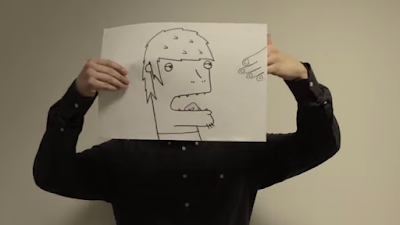
I will be using stop frames techniques with myself in frame, but also I will be animating my face using a piece of paper.

What will happen in your Esting?:

I will be standing in front of the camera holding a piece of paper in front of my face which will have a cartoon version of my face drawn onto it, then I will grab an E4 logo and consume it, before it quickly being thrown back up.

Where will your animation be set?:

My animation will be set simply in front of a white wall, I don't want too much in the background, this could be distracting.

Will there be any limitations to creating your Esting?: 

There certainly wont be any cost issues because I am only using a piece of paper pen etc, there wont be any travelling costs or complications, overall it is going to be fairly easy to do, although the main drawing will take the longest time because I have a lot of pictures to draw 

Who is the target audience for your Esting?:

It hasn't really got any content which would make it suitable for a certain age group, but it would be more enjoyable for the younger ages (15-30)

My Character:

An extremely rough sketch of my character is above, the character is me but as a cartoon, the picture isn't accurate but I wanted to put on a sketch to give you an idea. This character will be the one eating the logo. I am going to be dressed in casual, plain clothing (no large logos etc. due to copyright and neatness) 

Soundtrack:
For my Esting soundtrack I used one of the free ones from the E4 website.

My sets and location:


This is where I want to film (W12 the media room), I just want a white background so that my animation and movement is clear and easy to see, I was going to do it in front of a white curtain in W16 (a room at my college) but I believe that this would look too messy.  

For lighting I would like to bring these into W12 from W16 so that it looks better lit and clearer instead of using the room lighting

 Here is a quick sketch of what will happen:


Props:

A3 paper

Plastercine

DSLR Camera

Tripod

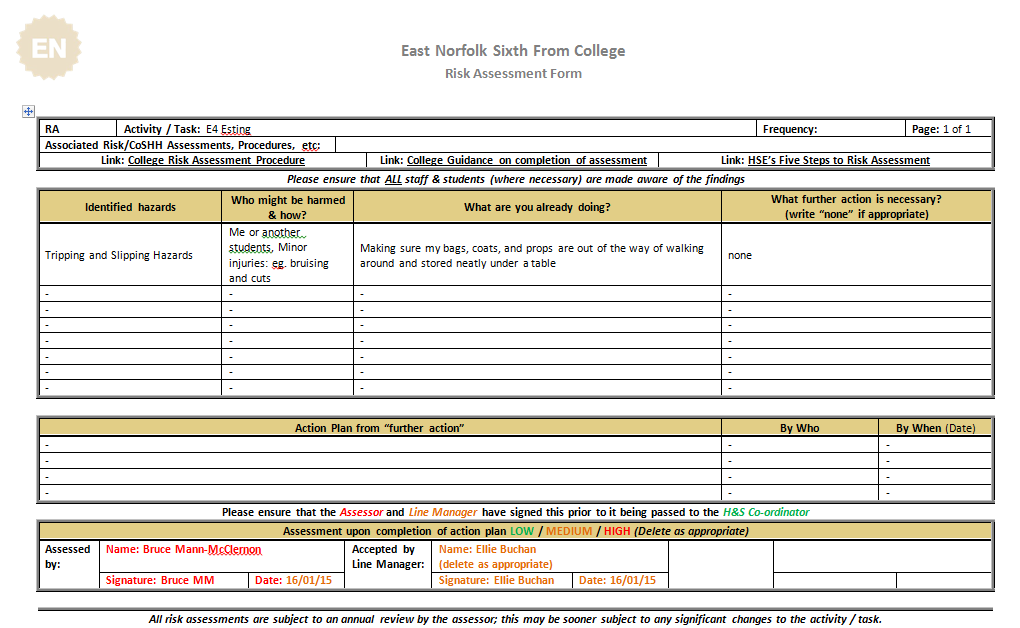
Risk Assessment:


Wednesday, 26 November 2014

Research and Planning: E4 and the Brief

E4

Who owns E4?: E4 is owned by Channel Four Television Corporation

How long have E4 existed?: E4 has been active for around 13 years, it was first launched on the 18th of January 2001

What programs are shown regularly on E4?:  The Cleveland ShowThe O.C.SmallvilleVeronica MarsEverwoodWhat About Brian?Desperate HousewivesHow I Met Your Mother90210One Tree HillUgly Betty,ScrubsRules of EngagementThe Big Bang Theory2 Broke GirlsRevenge, and formerly Friends. Other programming includes British shows such as SkinsMy Mad Fat DiaryMisfitsThe InbetweenersThe Ricky Gervais ShowShamelessHollyoaks, and Made in Chelsea . Some US imports, such as Desperate Housewives and Ugly Betty are screened on E4 up to one week ahead of their Channel 4 broadcasts.

Who is the primary TA?: 16-25 Middle Class, Students, Male and Female 


Who  is the Secondary TA?: 15-35

Which channels are owned by this broadcaster and who are they aimed at?: Channel 4, Film 4, More 4, Film 4, 4Music, Heat, Kerrang, KISS TV, Magic, Smash Hits, 4Seven, The Box. Same sort of age group (16-35)  

Part 2:

What is an E-sting and what is its purpose?: An esting is a ten second long ident which is created by people willing to create one for E4. Their purpose is to associate that program with the short clip by using E4's logo.


Genre: Comedy/surreal, due to the woman partying with sweats then at the end being licked by a sweet.

Audience: Young audience 15-30 year olds

This Esting shows an old lady in a sweet shop, licking an E4 lolly before being somehow sent to a sweet party on a higher shelf, and then she is picked up by a large E4 lolly man and licked, his reaction to the taste is bad.


Genre: Comedy, Due to the animation style and the face plant at the end.

Audience: Young to middle aged audience 15-40 year olds

This Esting shows the so called evolution of man, where a fish evolves into a man, and at the end as the man has evolved he face plants the floor.

References:
http://en.wikipedia.org/wiki/E4_%28TV_channel%29

https://www.google.co.uk/url?sa=i&rct=j&q=&esrc=s&source=images&cd=&cad=rja&uact=8&ved=0CAYQjB0&url=http%3A%2F%2Fwww.farnazglobal.com%2Fdo-you-really-know-20-somethings%2F&ei=n01vVP_qGdTxaN-CgfgF&bvm=bv.80185997,d.d2s&psig=AFQjCNHLpFP8331xK-aC_gC-7GkwGgI-Vg&ust=1416666900402323

https://www.google.co.uk/url?sa=i&rct=j&q=&esrc=s&source=images&cd=&cad=rja&uact=8&ved=0CAYQjB0&url=http%3A%2F%2Fwww.g64.org.uk%2Fclasses%2F16-18-year-olds.html&ei=0U1vVIm_Ao_faKedguAC&bvm=bv.80185997,d.d2s&psig=AFQjCNE273zAr1uwxnhGw0FMkFk5DCkyHg&ust=1416666867666357

Friday, 17 October 2014

The Techniques and Development of Stop Motion Animation

Joseph Plateau: 

Joseph Antoine Ferdinand Plateau was a Belgian physicist. He was the first person to demonstrate the illusion of a moving image.

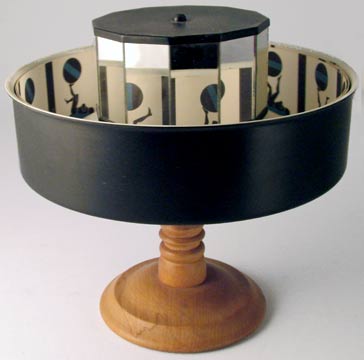
The Phenakistoscope was an early device which produced a moving image, the device consisted of a spinning disk which used a spinning disk of images which where in sequence so that when the disk was spun it ould appear that the image was moving although it was only an illusion. w


A Phenakistoscope in motion 
Phenakistoscope disk 


Although the idea behind the Phenakistoscope had  first been recognized by a Greek mathematician Euclid and later in experiments by Newton, it was not fully recognized and established until 1829 by Belgian Joseph PlateauPlateau planned it in 1839 and invented it in 1841. 

William George Horner:

William George Horner was a British mathematician; he was a schoolmaster, headmaster and school keeper, proficient in classics as well as mathematics, who wrote extensively on functional equations, number theory and approximation theory, but also on optics. He invented the Zoetrope.

The Zoetrope is a small circular device that produces the illusion of motion by displaying a sequence of drawings or photographs showing progressive phases of that motion.


The Thaumatrope:

There is no real inventor behind the Thaumatrope as lots of people made these as a toy during the 19th century as toys. 

The Thaumatrope was a disk attached to two pieces of string with an image on either side, when the strings were spun, it would appear the two images would of merged together.


Thomas Edison:

Thomas Alva Edison was an American inventor and businessman. He developed many devices that greatly influenced life around the world

The Kinetoscope is an early motion picture device. The Kinetoscope was designed for films to be viewed by one individual at a time through a peephole viewer window at the top of the device. The Kinetoscope was not a movie projector but introduced the basic approach that would become the standard for all cinematic projection before the advent of video, by creating the illusion of movement by conveying a strip of perforated film bearing sequential images over a light source with a high-speed shutter. 


Charles-Émile Reynaud:

Charles-Émile Reynaud was a French inventor, responsible for the first projected animated cartoons and for creating the Praxinoscope in.

The Praxinoscope was an animation device. It was invented in France in 1877 by Charles-Émile Reynaud. Like the zoetrope, it used a strip of pictures placed around the inner surface of a spinning cylinder.


Eadweard James Muybridge:

Eadweard James Muybridge was an English photographer important for his pioneering work in photographic studies of motion, and early work in motion-picture projection. He was responsible for creating the Zoopraxiscope.

The Zoopraxiscope is an early device for displaying motion pictures. Created by photographic pioneer Eadweard Muybridge in 1879, it may be considered the first movie projector. The zoopraxiscope projected images from rotating glass disks in rapid succession to give the impression of motion. 


Lumiere Brothers:

The Lumière brothers, Auguste Marie Louis Nicolas and Louis Jean are credited to be the first filmmakers in history. They patented the cinematograph, which contrary to Edison's "peepshow" kinetoscope, the former allowed viewing by multiple parties at once, like current cinema. "Lumière" is French for "light".

cinematograph is a motion picture film camera, which also serves as a film projector and printer. It was invented in the 1890s by the Lumiere Brothers. 


George Melies:

Georges Méliès was a French illusionist and filmmaker famous for leading many technical and narrative developments in the earliest days of cinema. Méliès, an innovator in the use of special effects, accidentally discovered the substitution stop trick in 1896, and was one of the first filmmakers to use multiple exposures,time-lapse photographydissolves, and hand-painted color in his work.

Music Videos

The animation used in this is stop motion, some of it is painted, some is real, and some of it is hand drawn. Tame Impala's music video uses painting for its stop motion


Movies

Team America (2004): This sort of animation is made by the use of marionettes (puppets). 


Iron Giant: The animation used in this is Stop-motion with drawings.


TV Programmes

South Park: This Program uses cut out animations, this is where shapes are cut out of paper or material to make a certain object like a human and is then animated using the same sort of animation as stop motion.


Creature Comforts: This is made by using models made out of clay, otherwise known as 'Claymation'. g


  • George Melies (optional)
  • Willis O'Brien
  • Ray Harryhausen
  • George Pal
  • Phil Tippett
  • The Brothers Quay
  • Tim Burton and Henry Selick
  • Otmar Gutmann
  • Aardman (Nick Park)
  • Adam Shaheen (Cuppa Cof

Willis O'brien

Willis Harold O'Brien was an American motion picture special effects and stop-motion animation pioneer, he particularly worked with models and figures, who created some of the best-known images in cinema history, and is best credited for his work on The Lost World (1925), King Kong (1933) and Mighty Joe Young (1949),he won the 1950 Academy Award for Best Visual Effects for this. 

Ray Harryhausen (June 29, 1920 – May 7, 2013)

Raymond Harryhausen  was an American visual effects creator, writer, and producer who created a form of stop-motion model animation known as "Dynamation."
His best known work include the animation on Mighty Joe Young (1949) this won an Award for Best Visual Effects. The 7th Voyage of Sinbad(1958), which was his first color film and Jason and the Argonauts (1963). His last film was Clash of the Titans (1981), after which he retired.
George Pal (February 1, 1908 – May 2, 1980)
George Pal was a Hungarian animator and film producer, who was associated with the science fiction genre. He was nominated for Academy Awards in the category Best short subjects of cartoon, for seven consecutive years (1942–1948) and received an honorary award in 1944. George Pal animated puppets 'Puppetoon'.

Phil Tippet (1951-Present)

Phil Tippett is an American movie director and a visual effects supervisor and producer, who specializes in creature design and character animation.

Films Phil Tippet has created creatures and animated characters in are below: (Quoted from Wikipedia)


The Brothers Quay (born June 17, 1947 - Present)

Stephen and Timothy Quay are American identical twin brothers better known as the Brothers Quay or Quay Brothers. They are stop-motion animators. They are also the recipients of the 1998 Drama Desk Award for Outstanding Set Design for their work on the play The Chairs. 

The Brothers Quay have worked on these films: (Quoted from Wikipedia)


Tim Burton (August 25, 1958) and Henry Selick  (November 30, 1952)

Henry Selick (born is an American stop motion director, producer and writer who is best known for directing The Nightmare Before Christmas, James and the Giant Peach and Coraline.

Timothy Walter or Tim Burton is an American film director, producer, artist, writer, and animator. 


He is known for his dark, gothic, macabre, and quirky horror and fantasy films such as the horror comedy fantasy Beetlejuice (1988), the romantic dark fantasy Edward Scissorhands (1990), the musical fantasy-thriller The Nightmare Before Christmas (1993), the comedy-drama biopic Ed Wood (1994), the fantasy adventure Sleepy Hollow (1999), the animated fantasy Corpse Bride (2005), the musical horror film Sweeney Todd: The Demon Barber of Fleet Street (2007), the horror comedy Dark Shadows (2012) and the animated horror comedy Frankenweenie (2012).

Otmar Gutman (April 24, 1937 - October 13, 1993)

Otmar Gutmann was a German television producer, animator, and director. He is well known for his long-running creation called Pingu. He is an animator of 'Claymation' this is where people animate characters and objects using pieces of clay, such as Pingu which he created. 

Aardman Animations


Aardman Animations is a British animation studio based in Bristol, United Kingdom. The studio is known for films made using stop-motion clay animation techniques, particularly those featuring Plasticine characters such as Wallace and Gromit.


 After some experimental computer animated short films in the late 1990s, beginning with Owzat (1997), they created Flushed Away (2006). Aardman films have made $926 million world wide and  an average of $154 million per film. All of their stop motion films are along the highest grossing stop motion film with Chicken Run being their top grossing film as well as the highest grossing stop motion film of all time.

Adam Shaheen (October 13, 1964 - Present)


Adam Shaheen is a British animator, television producer and screenwriter. He is the founder and owner of Cuppa Coffee Studios where he develops and produces all of the shows. He is also the executive producer of Cuppa Coffee’s award winning broadcast design and commercial studio.

Thursday, 25 September 2014

The Lumiére Brothers